EN
EN




- Overview
- Recommended Products
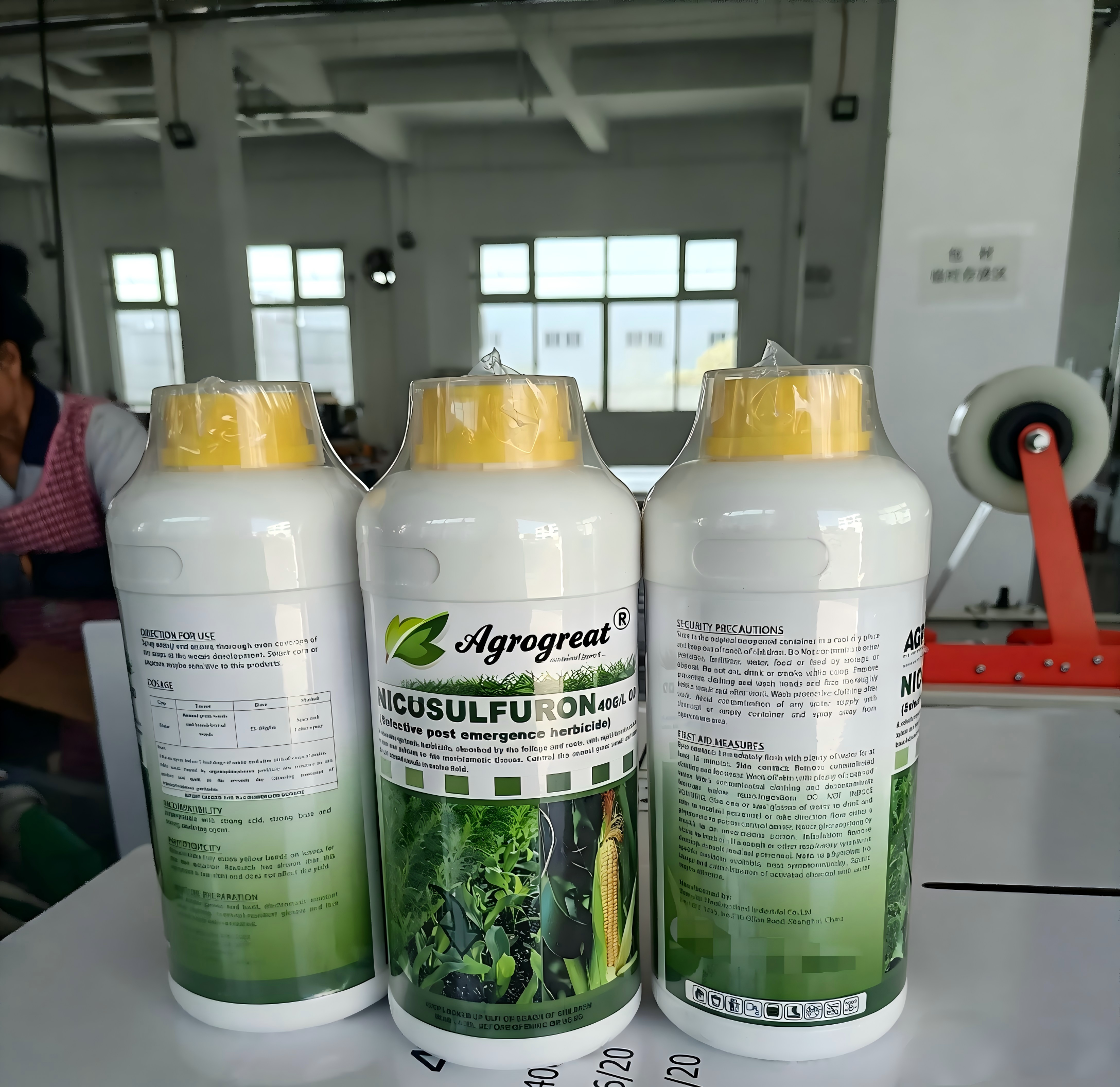
1.This product is a 40 g/L nicosulfuron oil dispersion (OD) formulation, belonging to the sulfonylurea class of selective post‑emergence herbicides. Nicosulfuron inhibits acetolactate synthase (ALS), a key enzyme in the biosynthesis of branched‑chain amino acids (valine, leucine, and isoleucine), thereby halting weed growth and leading to plant death.
2.It is specifically developed for use in corn (including field corn, sweet corn, and popcorn) to control a broad spectrum of annual grasses and certain broad‑leaved weeds, such as barnyard grass, crabgrass, foxtail, goosegrass, sprangletop, reed, cocklebur, velvetleaf, pigweed, and lambsquarters. Always apply according to the recommended rates within the registered and approved areas.
| Product Name | Nicosulfuron 40 g/L OD |
| Active ingredient | Nicosulfuron 40 g/L |
| Active ingredient content | 40 g/L |
| Formulation | OD, Oil Dispersion |
| Product Category | Herbicide |
| Pendimethalin CAS No. | 111991‑09‑4 |
| Main Uses | Selective post‑emergence herbicide for control of annual grasses and broad‑leaved weeds in corn |
| Targeted Pests and Diseases | Annual grass weeds (Echinochloa crus‑galli, Digitaria sanguinalis, Setaria viridis, Eleusine indica, Leptochloa chinensis, etc.) and broad‑leaved weeds (Xanthium sibiricum, Abutilon theophrasti, Chenopodium album, Amaranthus retroflexus, etc.) |
| Minimum Order Quantity | 1000L |
| Bulk packing | 1000L IBC drum, 200L drum, 20L drum |
| Small packing | 5L drum & 4drums/carton; 1L, 500ml, 250ml, 200ml, 100ml, 50ml bottle, 10L/carton |
| Documentation Support | ICAMA, COA, MSDS, TDS, Product Specifications,Packaging Information,etc. |
| Sample Service | Free for 200ml |
| Place of origin | China |
| Supplier | Agrogreat |
| Customized Services | bag, carton, logo Brand Customized |
Key Functions
Nicosulfuron is a systemic herbicide absorbed by both foliage and roots, with rapid translocation via both xylem and phloem to meristematic tissues. It acts by inhibiting acetolactate synthase (ALS), blocking the synthesis of essential branched‑chain amino acids. This leads to a cessation of cell division and growth in susceptible weeds. Symptoms appear within 2–5 days as chlorosis and necrosis of the growing points, followed by complete plant death within 1–3 weeks, depending on environmental conditions and weed species. The OD formulation ensures excellent leaf retention and penetration, providing consistent performance even under dry or cool conditions.
Key Benefits
1.Highly effective post‑emergence control of major annual grasses (barnyard grass, crabgrass, foxtail, goosegrass, sprangletop, etc.) and several problematic broad‑leaved weeds (cocklebur, velvetleaf, pigweed, lambsquarters, etc.) in corn.
2.Excellent crop safety when applied at the recommended timing (from 3‑leaf to 8‑leaf stage of corn); does not cause significant injury to corn hybrids that are tolerant or contain the appropriate metabolic trait.
3.OD formulation provides superior spreading and adhesion on weed foliage, enhances rainfastness (within 1 hour after application), and reduces drift and volatilization compared to traditional EC formulations.
4.Low use rate (40 g a.i./L) and favourable environmental profile; compatible with most adjuvants and tank‑mix partners, making it an ideal component of integrated weed management (IWM) programmes.
●The actual applicable crops and control spectrum shall strictly comply with the provisions of the locally registered label.
●The actual use instructions, crop range, diseases, application rates, and conditions of use are subject to the label.
●Do not apply to crops or diseases not specified on the local label.
| Applicable Crops | Targeted Diseases/Pests |
| Corn (field corn, sweet corn, popcorn) | Annual grasses: Echinochloa crus‑galli (barnyard grass), Digitaria sanguinalis (crabgrass), Setaria viridis (green foxtail), Eleusine indica (goosegrass), Leptochloa chinensis (sprangletop), Phragmites spp. (reed) |
| Corn (continued) | Broad‑leaved weeds: Xanthium sibiricum (cocklebur), Abutilon theophrasti (velvetleaf), Chenopodium album (lambsquarters), Amaranthus retroflexus (redroot pigweed), Polygonum spp., Portulaca oleracea (purslane) |